In the beginning there was THEMONK

The past two decades have been revolutionary for the communication industry.
If we look at it right now, it is clear to everyone that everything is “communication”.
The technology we use - and the way we use it - was born and continues to thrive because it comes with one clear, irresistible “product” to promote: our own lives, our feelings, our aspirations.
If we take a closer look, though, we can’t deny that this smorgasbord of technology and connections haven’t changed our profession that much: marketing and communication are still a craftsman’s job.
The environment has changed, and so have practices and expertise, but the person is still key.
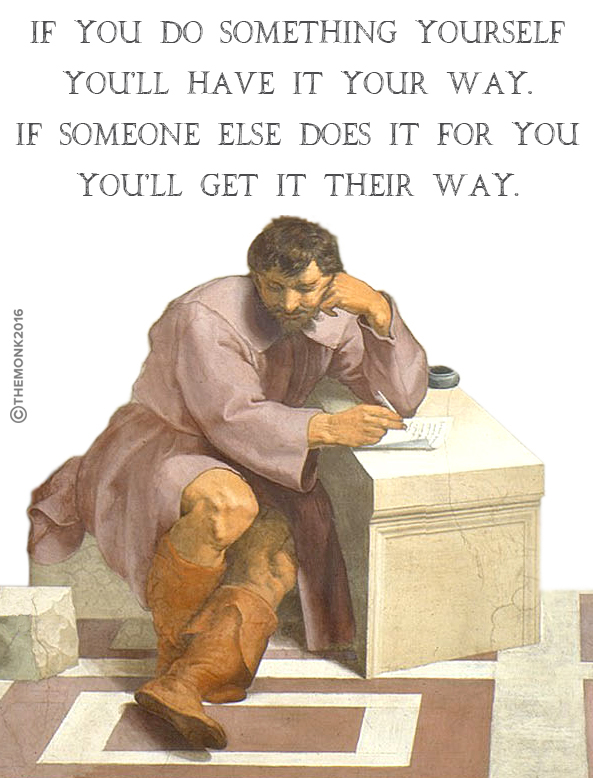
It might sound very old school, but you can’t deny that “If you do things yourself, you get things your way, if you let someone else do it, you’ll get them his way.”
Surveys, analyses, ideas, creativity, strategy, production, usability- they all keep giving different outcomes depending on who designs and executes them. The same goes for other jobs. But only in communication, with media and technology growing in number by the day, have the variables become so many. It’s all about the people, then. It’s all about the talent and quality they can bring to a project. Therefore, it’s all about the way a team is built and made to work. Which takes us to the third dramatic change in the industry: the agency model - that very structure which has been guaranteeing excellence in organizing work, people, and creative outputs. That model no longer works.
Ask anyone who has worked for big international networks, or in major corporate marketing departments – too often the skills of the people working on a project, and the skills required by it, do not match. The same technology and basic information are not fit for the mission, simply because you can’t fit all information and all technology inside the same agency. In the current scenario, skills and knowledge are scattered around the globe, while agencies, being tied to a fixed structure, can’t do anything but selling their clients whatever they can produce in-house. This is a problem to many, and an opportunity to some. And that’s where THEMONK comes into play.
It’s a closely-knit group of people bound by extensive experience in communication, marketing, and public relations for brands such as Bulgari, Philip Morris International, MSC Cruises, Nestlé, American Express, Silversea Cruises, Montblanc, Loro Piana, GNV, and start-ups like Yonderbound, etc.
If communication is still for professionals, THEMONK believes it’s all about the professionals you choose.
Having the best the brightest are not enough. They need to be in the ideal condition to produce ideal results. Because complex tasks require flexibility and speed, in ideation as well as in execution.
The strength is in the structure. THEMONK is freely founded upon direct relations, shaping up a network of specialists from all fields, all different in age, background, and experience. Its structure is lean, made to listen to clients closely, and assess, design, and manage work in a project-specific way.
Who are the MONKs.
You become a MONK: through acquaintance, based on talent, work capability, teamwork style, and a precise vision of the world of communication. No MONK is just in pursuit of award, rather he/she is there to work in the interest of the client.
As for involvement and compensation, the mechanism is simple: THEMONK scouts for projects, assesses them, and then brings in the MONKs with the most suitable profile, guiding the team so that the work satisfies the necessary standards, set by THEMONK himself: efficiency, quality, sharing.
THEMONK does not profit from the talent of his collaborators. The structure - inspired by the lightness of Japanese temples, which are meant to be constantly taken down and built again – operates on minimal managing and operational costs. Profits are therefore distributed equally among the members of each working team.
Under this point of view, the advantages of MONKs perfectly match the benefit of clients.
THEMONK’s mission is, indeed, to help businesses manage communication in a time of complexity and change. This means strategies, ideas, project – but, above all, new professionals, people who place effectiveness above personal exposure.
THEMONK